
-
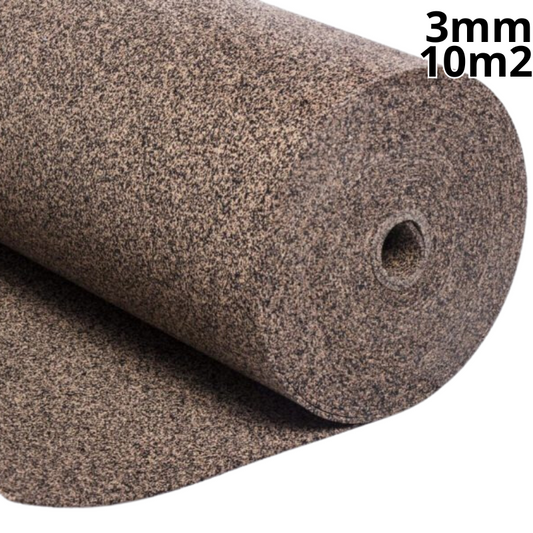
Rubber Cork - 3mm - 10m2 (107.63 sqft)
Regular price £84.99 GBPRegular priceUnit price per -
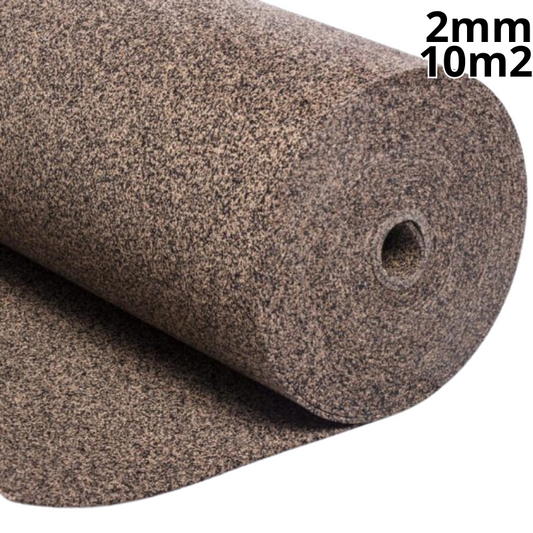
Rubber Cork - 2mm - 10m2 (107.63 sqft)
Regular price £63.99 GBPRegular priceUnit price per -
Rubber Cork Sheet Roll - 1000x1000mm - 2mm - Decor and DIY - Pack of 1
Regular price £25.99 GBPRegular priceUnit price per -
Rubber Cork - 4mm - 10m2 (107.63 sqft)
Regular price £104.99 GBPRegular priceUnit price per


What Is Rubber Cork and Why Does It Perform So Well
Rubber cork is a composite material produced by bonding natural cork granulate with rubber - typically synthetic rubber - under heat and pressure. The result combines the thermal and acoustic insulation properties of cork with the flexibility, compressive strength, and chemical resistance of rubber. Neither material alone achieves the same performance envelope: cork provides the natural cellular structure that traps air and absorbs energy, while rubber adds resilience, dimensional stability under sustained load, and resistance to oil, moisture, and mechanical wear.
The bonded composite is characterised by high density and mechanical resilience, making it abrasion-resistant and dimensionally stable even under prolonged compression. Unlike pure foam or sponge insulants, rubber cork does not collapse or lose its properties over time - it maintains its thickness, its insulation performance, and its vibration-damping effectiveness throughout its service life. For applications where long-term reliability matters more than initial cost, rubber cork consistently outperforms synthetic alternatives.
Rubber Cork - Available in 2mm and 3mm Thickness
CorkSystem's rubber cork range is available in two thicknesses - 2mm and 3mm - each supplied in a 10 m² (107.63 sq ft) roll. The choice of thickness depends primarily on the application.
2mm rubber cork is well suited to applications where minimal additional height is critical - beneath thin flooring formats such as LVT, vinyl, and ceramic tiles, as a gasket and sealing material in construction joints, and for surface protection applications where a thin, consistent layer of cushioning and insulation is required. At £63.99 for a 10 m² roll, it offers exceptional value per square metre for projects where coverage matters.
3mm rubber cork provides greater acoustic and thermal performance, making it the preferred choice for flooring underlays beneath laminate, engineered wood, and solid wood floors, as well as for anti-vibration applications under machinery, appliances, and mechanical equipment. At £84.99 for a 10 m² roll, the 3mm format delivers the performance of a premium underlay at a fraction of the cost of specialist acoustic products.
Both formats are supplied as continuous rolls, allowing them to be cut to any required size and shape using a sharp utility knife - no specialist tools required.
Thermal and Acoustic Insulation Properties
The thermal conductivity of natural cork sits between 0.037 and 0.040 W/(mK), placing it among the best-performing natural insulation materials available. In a rubber cork composite, that thermal performance is maintained and enhanced by the rubber component's own low thermal conductivity, creating a material that resists heat transfer effectively across a wide range of temperatures. For floor underlays in particular, this means a noticeably warmer surface underfoot - not just in how it feels, but in how the floor system performs in energy terms over time.
Acoustically, cork absorbs between 30% and 70% of sound energy across the frequency range from 400 to 4000 Hz. The rubber component adds further resilience and compressibility, improving impact noise attenuation - the type of noise generated by footsteps, dropped objects, and mechanical vibration. A 3mm rubber cork underlay provides meaningful impact sound reduction that makes a real difference in multi-storey homes, flats, and commercial buildings where noise transmission between floors is a persistent problem.
Anti-Vibration and Industrial Applications
One of the most important and often overlooked applications for rubber cork is vibration control. The combined density and elasticity of the cork-rubber composite makes it one of the most effective natural materials for absorbing and isolating mechanical vibration. Under washing machines, tumble dryers, dishwashers, and other domestic appliances, a rubber cork pad eliminates the transmitted vibration that causes noise in adjacent rooms and structural wear on floor surfaces over time.
In industrial and commercial environments, rubber cork is used as anti-vibration mounting material under machinery, compressors, pumps, and HVAC equipment. Its resistance to oil, moisture, and mild chemicals - properties contributed primarily by the rubber component - makes it suitable for use in workshops, plant rooms, and utility spaces where a purely natural cork product would be less durable. The material's compressive strength and dimensional stability under sustained load mean it continues to isolate vibration effectively even when carrying significant weight over extended periods.
Beyond flooring and machinery, rubber cork is widely used as a sealing and gasketing material in construction and engineering applications - expansion joints, pipe penetrations, structural movement joints, and sealing interfaces where a flexible, compressible material is needed that also provides thermal and acoustic separation.
Eco-Friendly and Sustainable by Composition
Despite its industrial-grade performance, rubber cork remains a predominantly natural material. The cork component is harvested from the bark of cork oak trees (Quercus suber) without felling the tree, with the bark regenerating naturally over nine to twelve years. Cork is fully biodegradable, free from VOCs, and requires no harmful chemical additives in its production.
For UK homeowners, designers, and contractors committed to using natural and sustainable materials wherever possible, rubber cork offers the same environmental credentials as standard cork products while delivering the enhanced performance that demanding applications require. It is a material that sits comfortably within a sustainable specification - not as a compromise, but as a genuinely high-performing choice that happens to be natural. For projects where natural cork sheet alone provides sufficient performance, our cork sheet range offers a complementary selection of pure cork products in various thicknesses.
Easy to Cut, Install, and Maintain
Working with rubber cork rolls is straightforward. The material cuts cleanly with a sharp utility knife and metal straightedge, holds its shape accurately once cut, and bonds well to most common substrates using appropriate adhesives. For flooring underlay applications, the roll can be laid directly on the subfloor with joints butted tightly together, trimmed at edges and around obstructions, and the finished floor installed on top without adhesive.
For fixed installations - anti-vibration pads, wall panels, sealing applications - a suitable contact adhesive applied to both surfaces provides a strong, lasting bond. The rubber component of the composite is compatible with most contact adhesives, and the material's density means it sits flat and bonds evenly without air pockets or lifting edges. Maintenance requires nothing more than a damp cloth - the rubber cork surface does not absorb liquid and resists staining, making it practical in exactly the kind of demanding environments where it's most commonly used.
FAQ - Rubber Cork
Q: What is rubber cork and how is it different from natural cork?
A: Rubber cork is a composite material made by bonding natural cork granulate with rubber under heat and pressure. It retains all the thermal and acoustic insulation properties of natural cork while adding the flexibility, compressive strength, chemical resistance, and dimensional stability of rubber. It outperforms natural cork alone in high-load, high-vibration, and chemically demanding applications.
Q: What thicknesses and sizes are available?
A: CorkSystem's rubber cork is available in 2mm and 3mm thickness, both supplied as 10 m² (107.63 sq ft) rolls. The 2mm roll is priced at £63.99 and the 3mm roll at £84.99. Both formats can be cut to any required size and shape using a standard utility knife.
Q: Which thickness should I choose for a flooring underlay?
A: For most flooring underlay applications - beneath laminate, engineered wood, or solid wood floors - the 3mm rubber cork provides better acoustic and thermal performance and is the recommended choice. The 2mm format is better suited to thin flooring systems such as LVT and vinyl, where additional height is restricted, or for sealing, gasketing, and surface protection applications.
Q: Can rubber cork be used under underfloor heating?
A: Rubber cork has a relatively low thermal resistance compared to thick foam insulants, which means it allows heat to pass through to the floor surface efficiently. It is generally compatible with underfloor heating systems, but we recommend checking the maximum underlay thermal resistance specified by your underfloor heating supplier before installation - particularly for electric mat systems.
Q: Is rubber cork suitable for use under heavy machinery and appliances?
A: Yes. The high density, compressive strength, and dimensional stability of rubber cork make it particularly well suited to anti-vibration applications under washing machines, tumble dryers, dishwashers, compressors, and other mechanical equipment. It absorbs vibration effectively under sustained load without collapsing or losing its damping properties over time.
Q: How do I cut and install rubber cork rolls?
A: Rubber cork cuts cleanly with a sharp utility knife and metal straightedge. For floating underlay applications, lay the roll directly on the subfloor and butt-join the edges without adhesive. For bonded installations, apply a suitable contact adhesive to both the rubber cork surface and the substrate, allow to become touch-dry, then press firmly into position. The material bonds reliably to most common substrates including concrete, plywood, plasterboard, and existing floor finishes.
Q: Is rubber cork an eco-friendly material?
A: Yes. The cork component is harvested from cork oak bark without harming the tree, is fully biodegradable, and contains no VOCs or harmful chemical additives. While the rubber component is typically synthetic, the overall composite remains a more sustainable choice than purely synthetic foam or plastic-based insulants - combining natural raw material credentials with long service life and genuine recyclability at end of use.
CorkSystem - Natural Cork, Outstanding Performance. Free delivery available on 90% of products across the UK.